Rich renter, poor owner
17 July 2026
← back
Owning your home is a rich person thing, right? Our own experiences confirm this beyond doubt and statistics show us the extent of the divide. According to the Federal Reserve the median homeowner has 40x the net worth and 2x the income of the median renter. The European Central Bank reports smaller but still sizeable differences, with 16x and ~2x respectively.
And yet, in Europe, richer countries have a lower ownership rate than poor ones.
My first reaction when I see this is to sound the alarm. We are being lied to! Under the appearance of material progress we are all becoming dispossessed!! We pay streaming subscriptions instead of buying DVDs, we use Lime bikes instead of having one... and we rent instead of owning!!!
But let's be diligent thinkers, consider alternative explanations and challenge this first conclusion.
Poorer country, larger household, fewer renters
To some extent, this relationship is a product of households being larger in poorer countries.
The data's unit of analysis 11 Which means the smallest entity you look at in your analysis. If you compare countries, the unit of analysis would be "countries", and if you do opinion surveying it would be the "persons". is the household. Percentages do not represent the proportion of citizens in the country that own, but rather the proportion of homes in the country that are inhabited by their owners.
Thus, if people who do not own a house tend to live with family members (e.g. parents) or friends who do, then there will be less renting and the percent of households inhabited by their owners will be larger. And this seems to hold for poorer countries. In the poorer half of the countries, households are 14% larger on average than in the richer half.
But this is not a very large difference. And, indeed, after controlling 22 For the statistically inclined. In order to estimate the direct effect, we perform a humble partial correlation between GDP per capita and ownership rate, controlling for household size. A normal Pearson correlation sits around -0.65, and the partial correlation remains at -0.60. for household size we still observe a very strong negative relationship between wealth and ownership rate.
So this cannot be the explanation.
Move one house to the right
As we have established, the statistic looks at the proportion of homes that are occupied by their owner. Imagine a country where every household owns a house but they all rent it out and live as someone else's tenant. Then, in this country the ownership rate would be 0%. This is an extreme case, but it shows why we cannot conclude that few households own a house from the fact that the ownership rate is low.
Thus, our data could be explained by richer countries' citizens engaging in rental even though they own a house. Nevertheless, the authorities on the matter (i.e. scholars, OECD) point at a different explanation.
A Soviets' goodbye present
Let's start with a map.
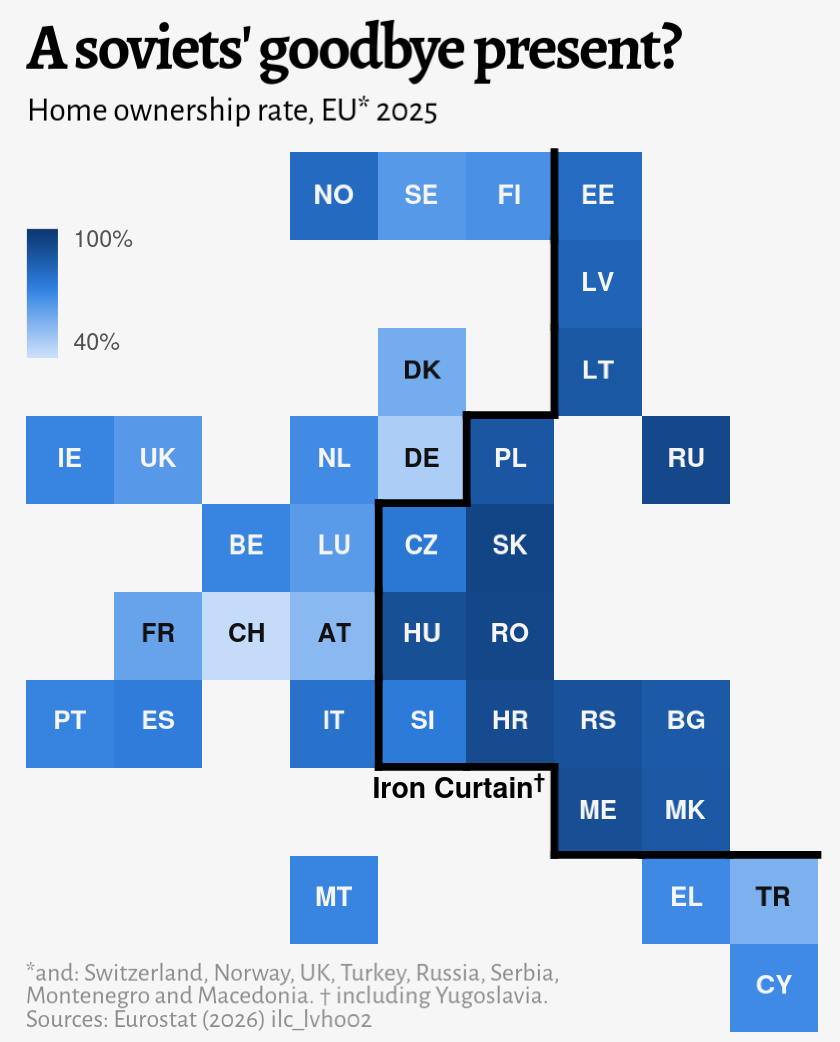
The pattern is clear: former Eastern Bloc republics have a much higher ownership rate. And as it happens, poorer European countries tend to be former Eastern Bloc republics (i.e. 83% of the poorer half). Thus, the explanation for why poorer countries have a larger ownership rate seems to be: they once had a state socialist government. And now we have to answer why countries with a state socialist past have this high rate.
The answer lies in their 1990s transition from central-planning to market-based economies. Given their economic system, for decades the state was in charge of housing its citizens. It owned a substantial portion of the housing stock and made it available through social-rent. When the USSR collapsed and they had to swiftly transition to a market economy, this had to change.
To do so, the state allowed tenants to buy their homes at huge discounts. This partly followed World Bank recommendations, who expected total privatization would help develop mature housing markets (i.e. mortgages, private rentals). In part it also followed the governments' interests: they hoped home giveaways would calm a population struggling with economic difficulties and a political vacuum. But, overall, the main effect this decision had was driving ownership rates through the roof, creating super-ownership housing regimes.
The contradictory relation between wealth and home ownership seems to be, largely, the effect of this policy.
Back to my original alarm
As I was saying before... We are being lied to! Under the appearance of material progress we are all becoming dispossessed!! etc...
Having challenged this initial interpretation, it seems the data is not explained by a process where development of a country leads to dispossession of its citizens. Instead, it is explained by the state socialist past of poorer European countries.
This being said, I am still left alarmed, concerned, or at least suspicious.
We cannot conclude that the poorer eastern European countries are "doing better housing-wise". This is a rather complex assessment. We should take into account the quality of the housing. We should also clarify the effect "renters who also own a house" are having on richer countries' statistics. And we should study the situation of those people who did not get a very cheap house in the 1990s (e.g. youth, immigrants).
Nevertheless, we cannot rule it out either. According to the OECD, in Europe 65% of renters are "concerned" or "very concerned" about "being able to find/maintain adequate housing". This percentage drops to 36% for owners. These statistics together with the discussed ownership rate, would suggest that in poorer European countries fewer people find housing a concern 33 OECD data includes few eastern European European countries (i.e.Poland, Slovenia, Baltic states), preventing a direct comparison. Poland and Slovenia show some of the lowest percentages, below countries like Germany, the Netherlands or Switzerland. But the Baltic states show rather high ones, weakening the argument. .
Similarly, on average in the EU 12% of people identify housing as "one of the two most important issues facing" their country. This percentage goes down to 7% for eastern European countries.
Bottom line: It is unclear whether citizens in richer, more "developed" countries have a better housing situation. Concerning...